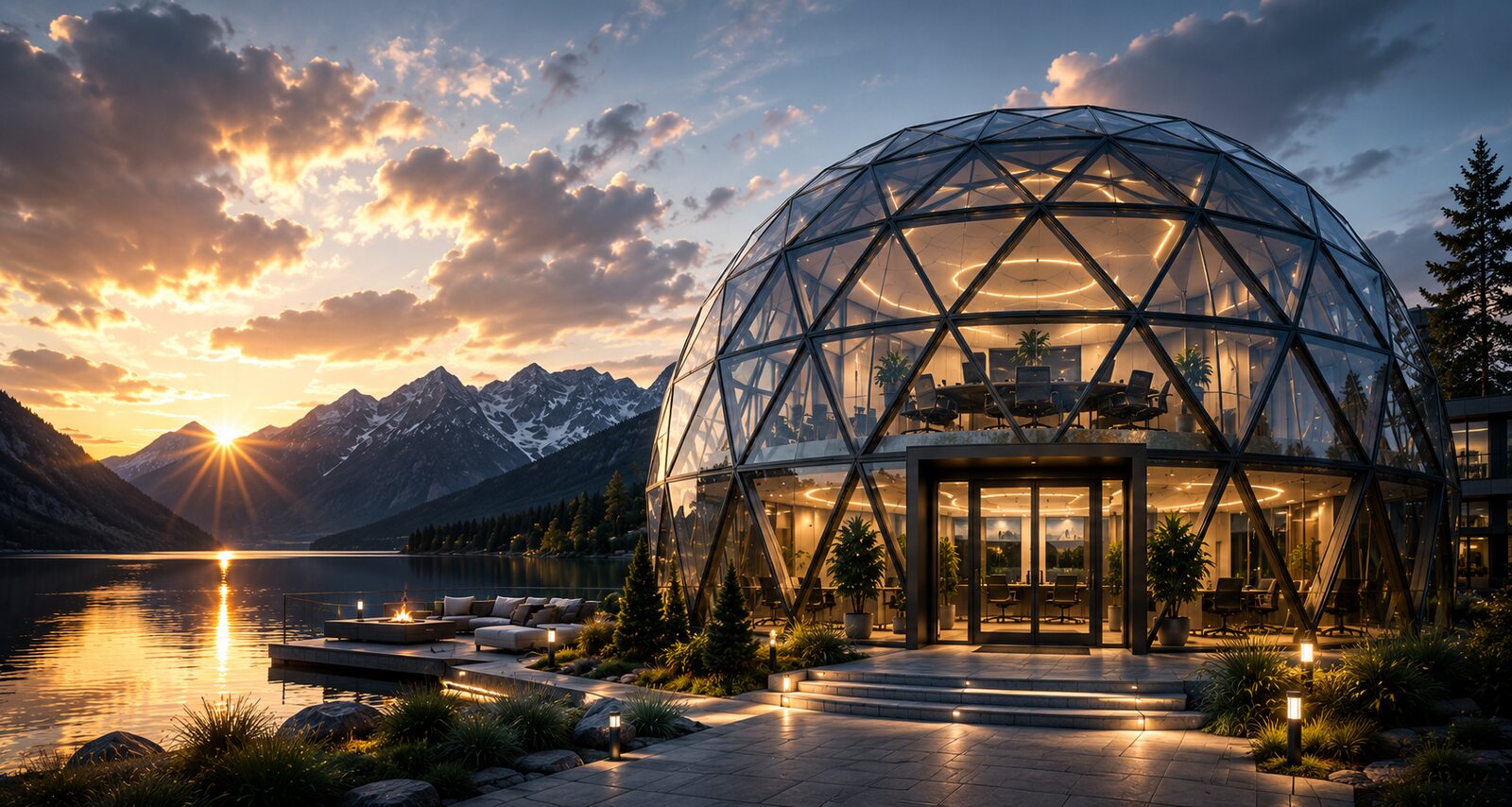
Premium glass office domes
Glass dome offices and aluminium-glass facades
For projects that need light and engineering. The office of the future should not look like a box — GEODOMAS creates dome offices, AI LAB, innovation centres and administrative campuses.
Premium product routes
Glass offices that become your company's architectural signature.
GEODOMAS glass dome offices are built as a modular business-building system: from one representative office dome to multi-block administrative campuses with aluminium-glass facades, composite segments and real engineering logic.
Team Studio
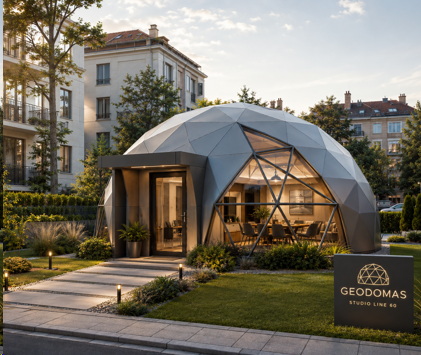
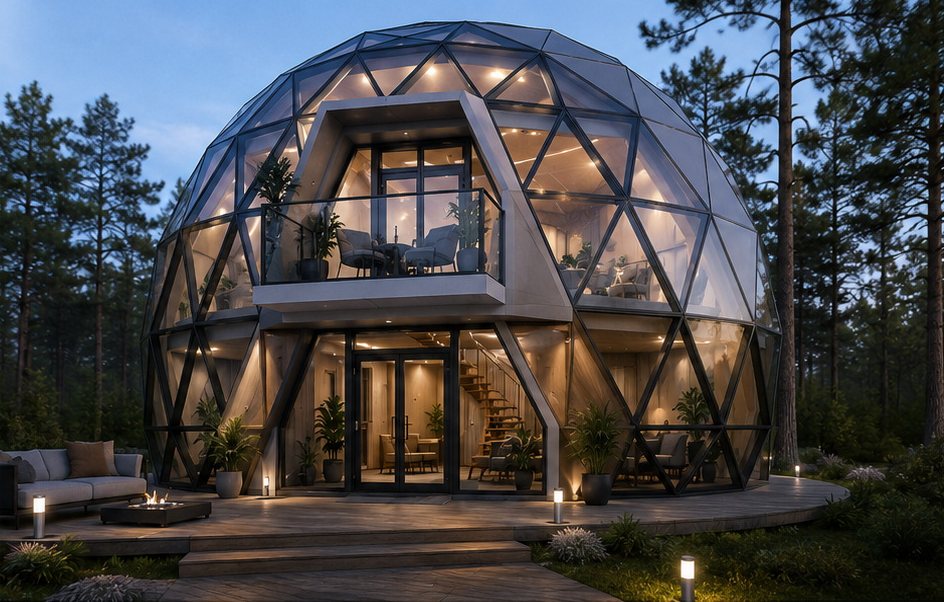
A single glass dome office for a small business, showroom, sales space or a representative client reception area.
- Models from 50 m² to 120 m²
- 1 storey with optional mezzanine
- Glass + 10–30% composite
Two-storey office building
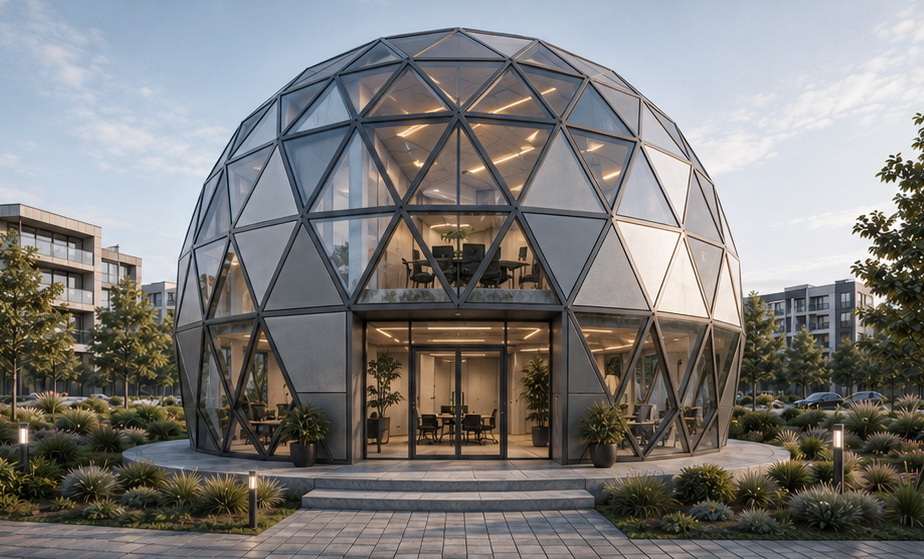
Glass dome office for a mid-size business, client reception, showroom, sales space or a representative executive zone.
- Models from 80 m² to 300 m²
- 2 storeys with optional mezzanine
- Glass + 10–30% composite
Three-storey office building
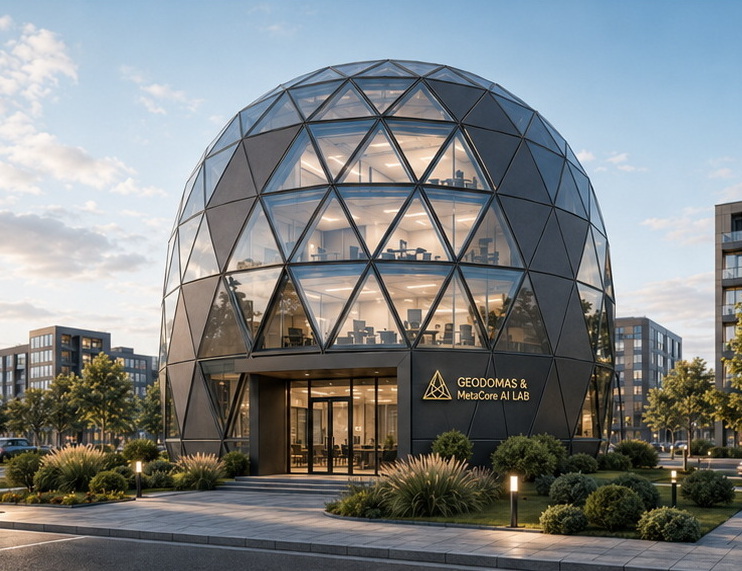
Larger glass dome office for a business centre, client reception, conferences, showroom or a representative administration zone.
- Models from 200 m² to 850 m²
- Conferences / offices / lounge
- Clear business-centre scenario
Business complexes
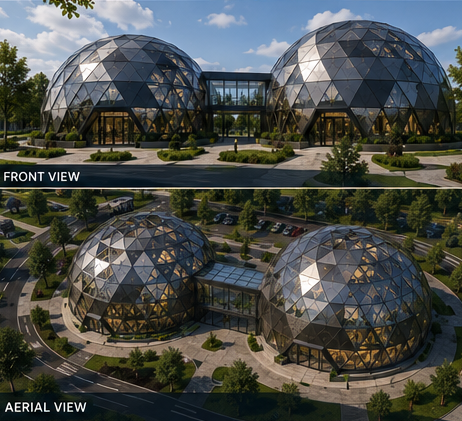
Multiple domes are joined into complexes: for offices, conferences, education, exhibitions or mixed commercial use.
- Up to multi-block structures
- 1000 m² - 5000 m² ir daugiau
- Premium HQ / innovation centre
Aluminium–glass system
An A++ glass dome building is not decoration — it is a full engineering system.
GEODOMAS administrative and office domes are designed as real multi-layer buildings: monolithic reinforced-concrete slab, radial engineering, load analysis, heavier aluminium profiles, triple glazing units, ventilated composite zones and a factory-prepared assembly sequence.
Engineering-ready A++ logika
A premium building needs a heavier profile, node logic and a real construction sequence.
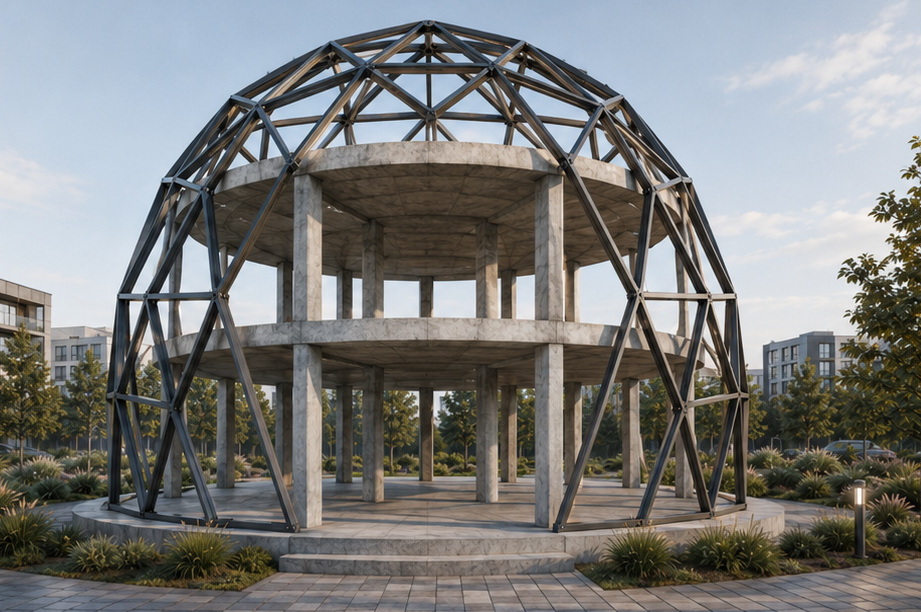
Here the dome works as an external architectural envelope and facade system, while inside a full administrative building is formed with floors, columns, service shafts, office zones and linking blocks.
01 / Monolithic base
The base is formed from an insulated reinforced-concrete slab with radial and ring reinforcement logic, anchor plates, waterproofing, underfloor heating and all MEP connections.
02 / Radial engineering
The dome building is planned not as a rectangular volume but by sectors and zones: water, drainage, power, service shafts and heating circuits are integrated to dome geometry.
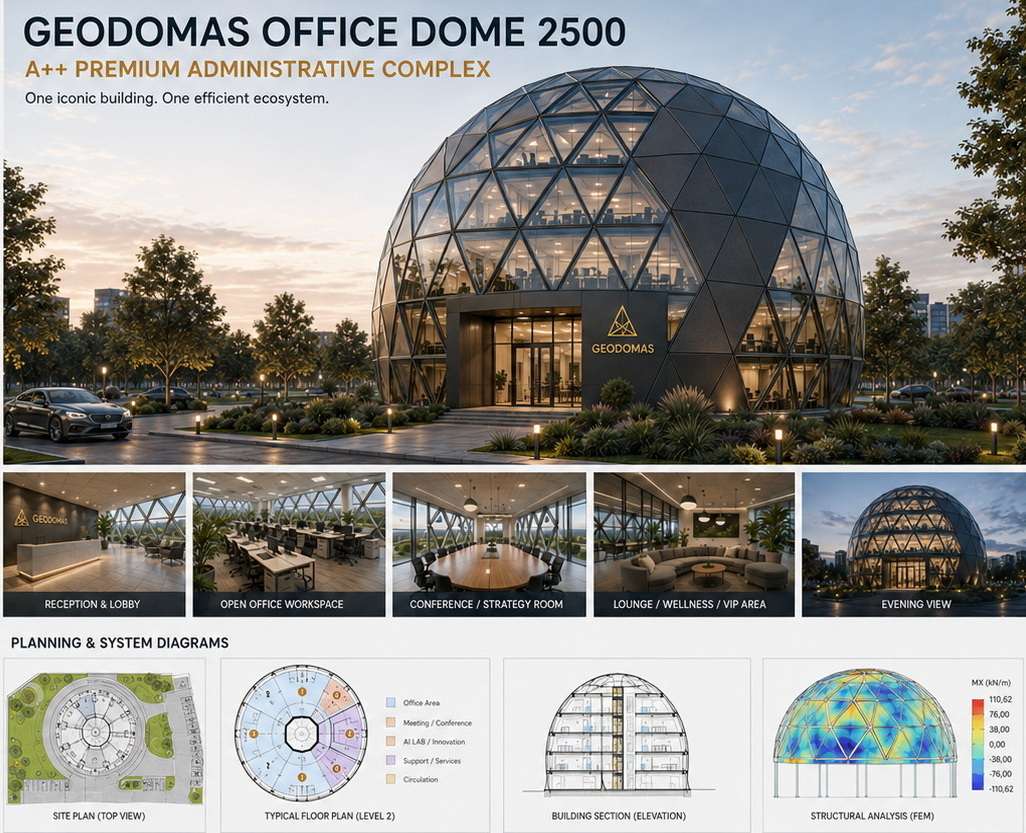
03 / Structural analysis
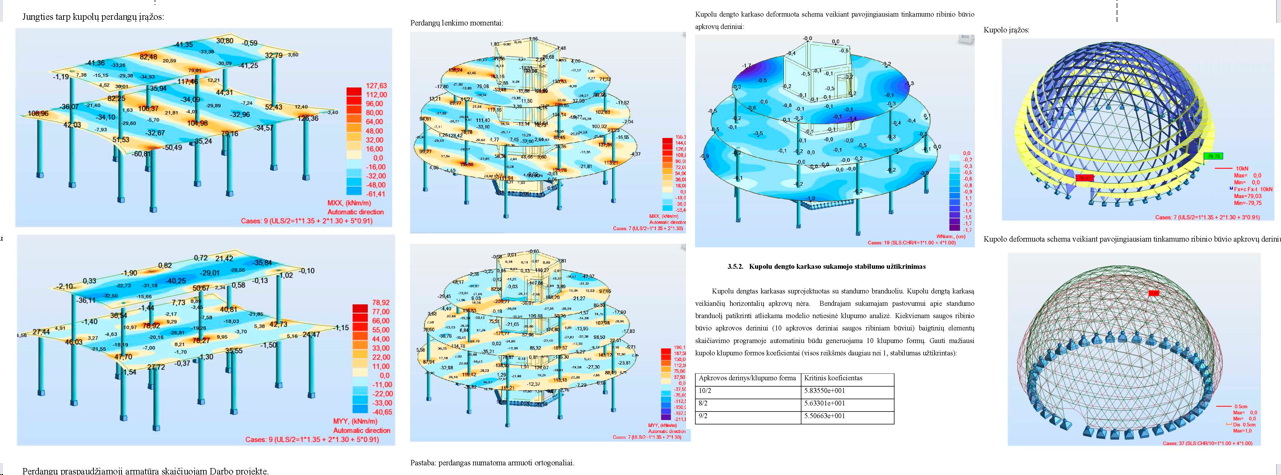
Design relies on FEM calculations, wind, snow, operational loads, settlement, thermal bridges, moisture and condensation analysis. This selects precise nodes, profiles and facade layers.
04 / Facade system
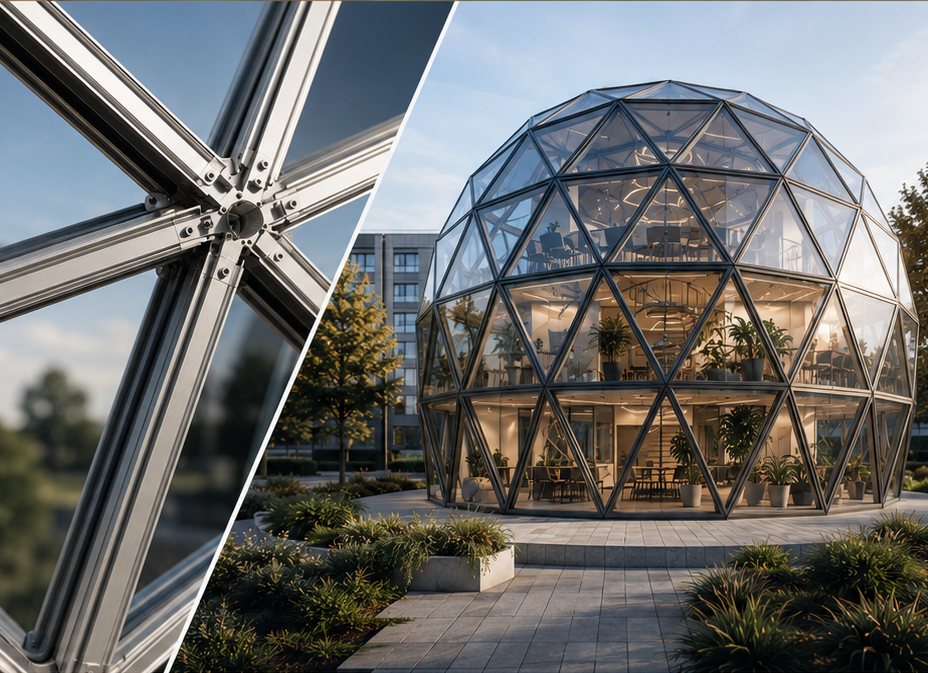
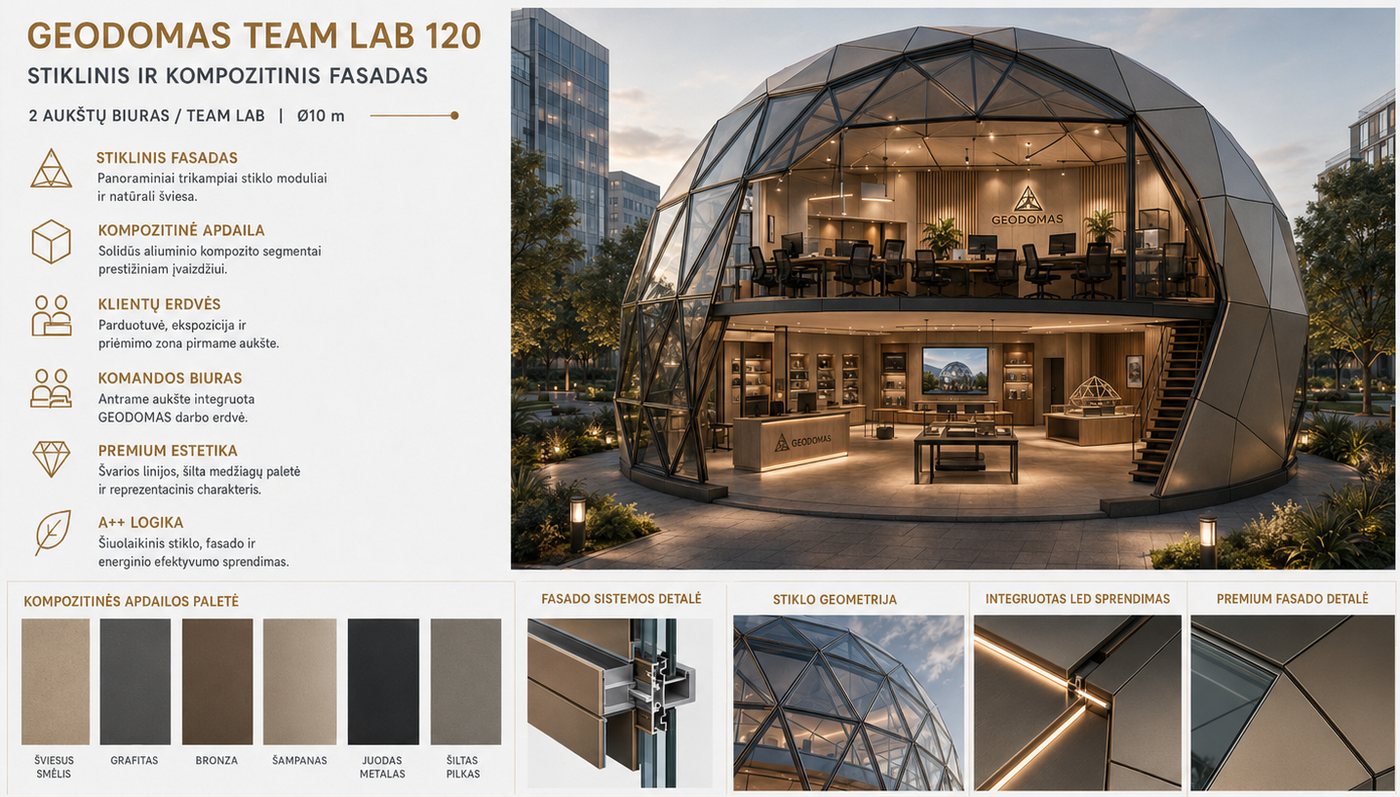
The facade is built as aluminium triangular profiles + selective glass + ventilated composite system controlling light, heat, privacy and architectural expression.
SSP1 Heavy Office Facade A++ route
For larger administrative domes, heavier triple glazing units, higher loads and long-term representative operation. Profilis GEO-GLZ-FRM-PRF-SSP1.
SSP2 Compact Glass Dome compact solution
A lighter system for smaller offices, showrooms, orangeries, hospitality and mixed-use buildings, where a premium glass volume with a more rational facade load is needed.
Composite Control Zones 10–30% of facade
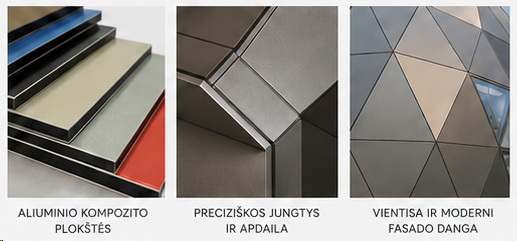
Opaque triangles are used for solar control, privacy zones, service areas, shading and facade rhythm. ACP / aluminium composite panels are used with ventilated cladding logic.
SSP1 Heavy / A++
For larger offices, campuses, public and representative buildings where heavier profiles, loads, triple units and a long operational cycle matter.
SSP2 Compact
For more compact showrooms, studios, restaurants, orangeries and glass–composite balance when a rational premium solution is needed.
Complete Dome Wall System
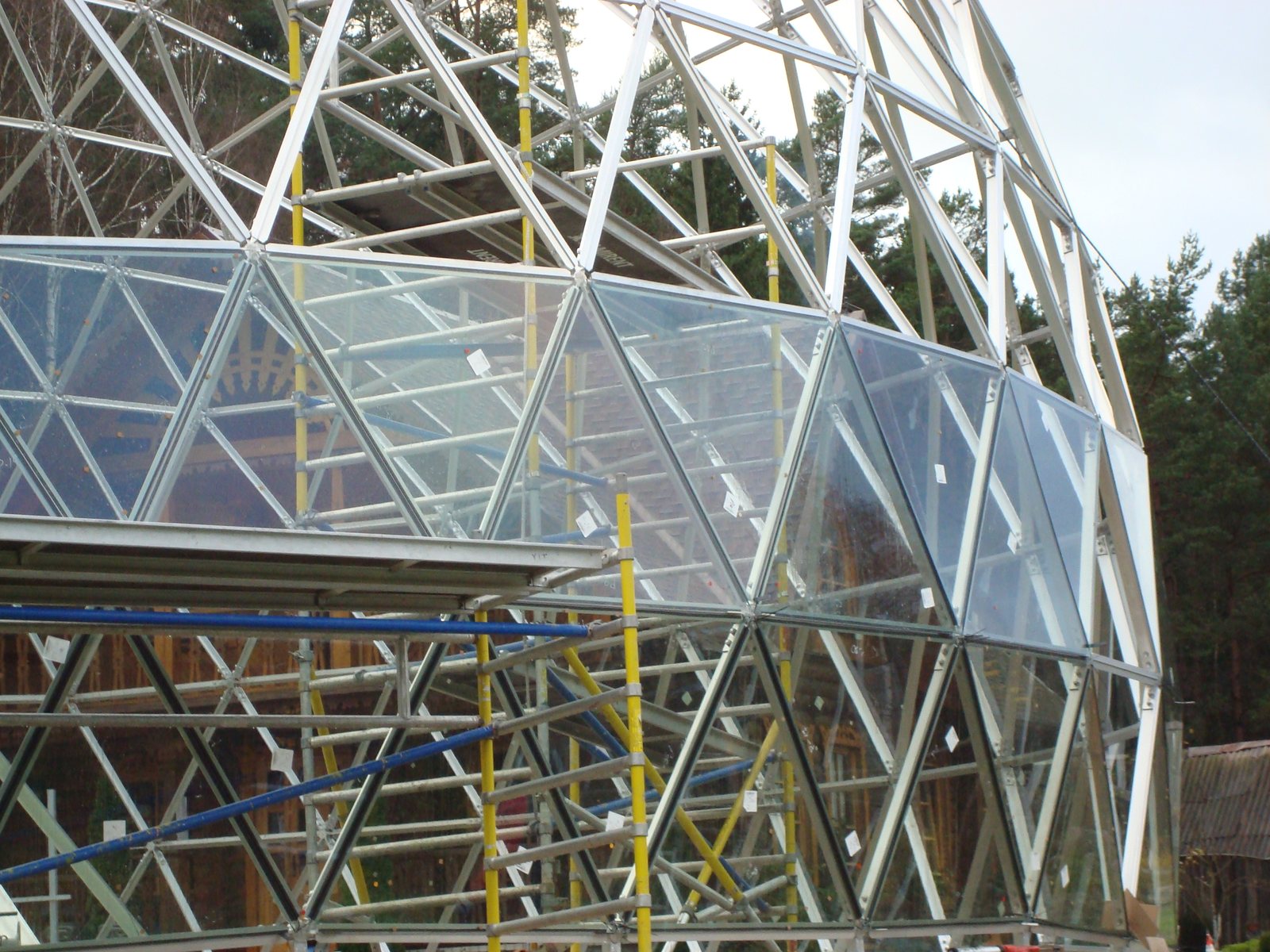
Multi-layer A++ dome wall / facade system
- Internal finish / interior panel
- Service cavity for utilities
- Vapour-control layer
- Thermal insulation
- Structural triangular frame
- Triple selective glazing unit or composite panel
- External protective / ventilated facade layer
Technology process
From foundations to handover — a clear A++ administrative dome construction sequence.
GEODOMAS kupolas modeliuojamas kaip factory-prepared modular administrative dome: elements are prepared in the factory, numbered, packed and assembled on site in a precise sequence.
- Site preparation and ground layers
- Reinforcement, utility connections and perimeter anchors
- Reinforced-concrete slab pour
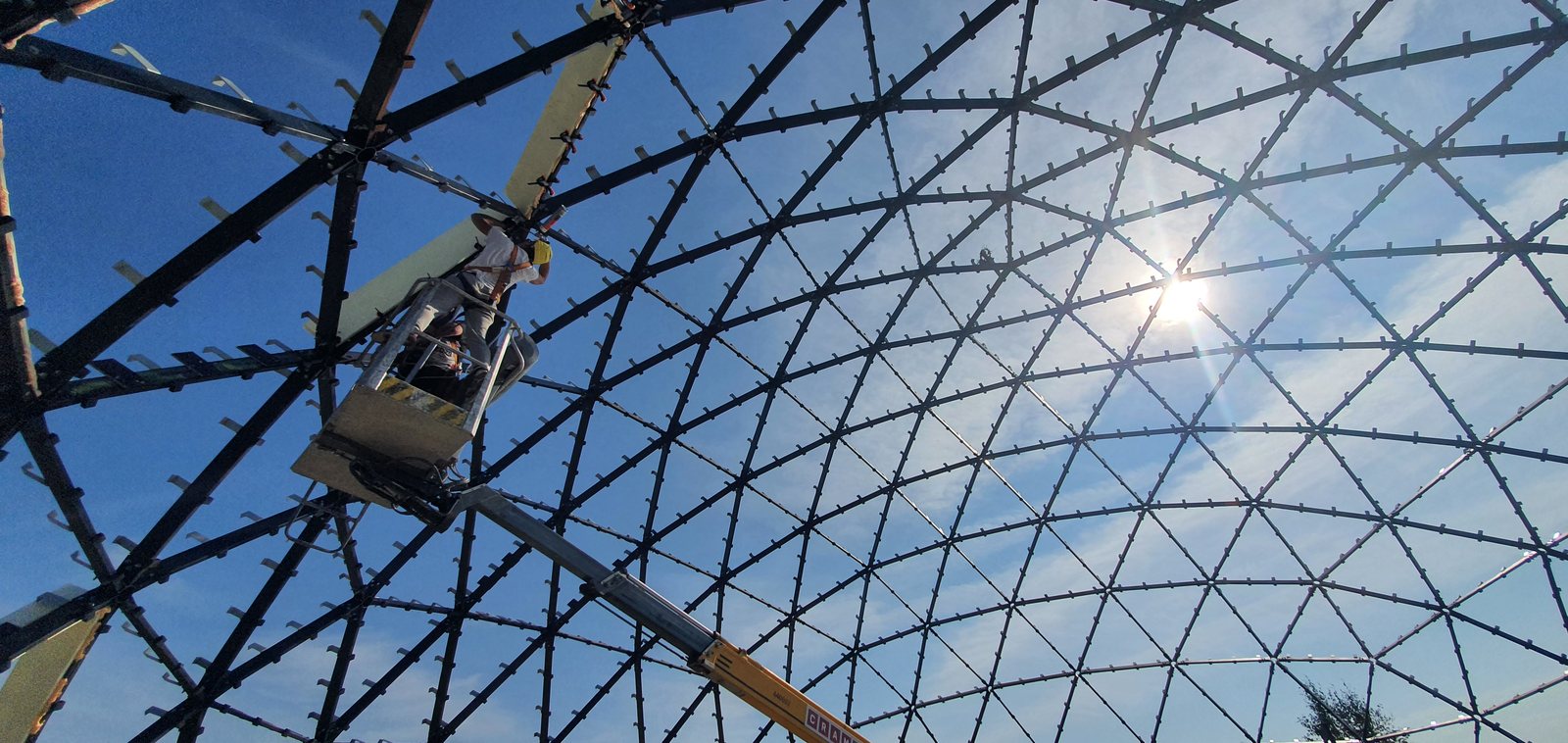
- Geodesic frame assembly
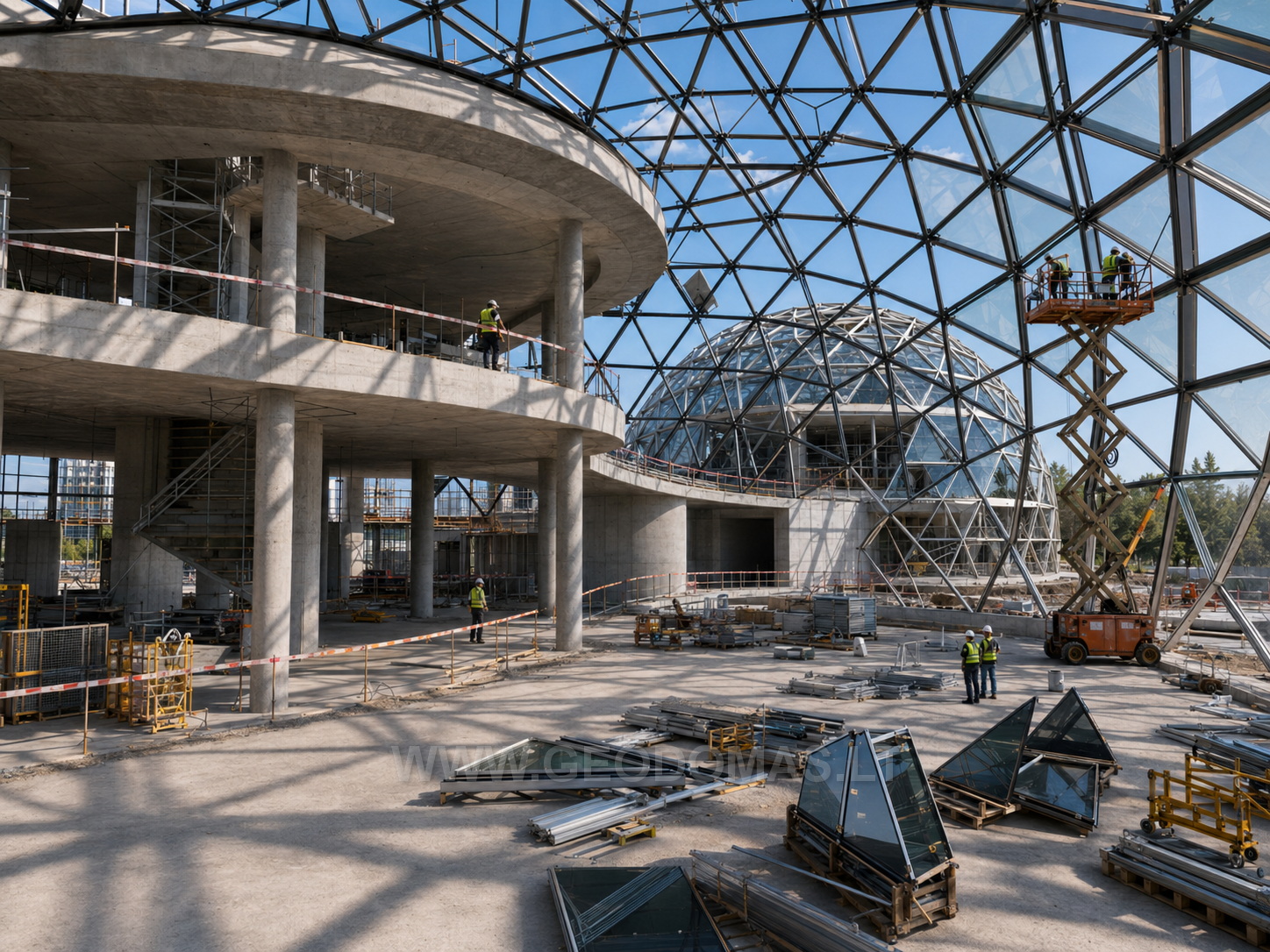
- Internal columns, floors and shafts
- Linking block / corridor structure
- Triangular facade module assembly
- Glazing units and composite panels
- Airtightness, thermal and drainage layers
- Internal finishes, MEP, HVAC, BMS and quality control
INFOSTATYBA-level documentation
GEODOMAS Office Dome Campus — from vision to permit-ready technical design.
A glass administrative dome is not just visualisation. It is a file system: site, architecture, structures, HVAC, electrical, fire safety, security systems, construction organisation and production-ready aluminium–glass facade logic.
Office Dome Campus DNA
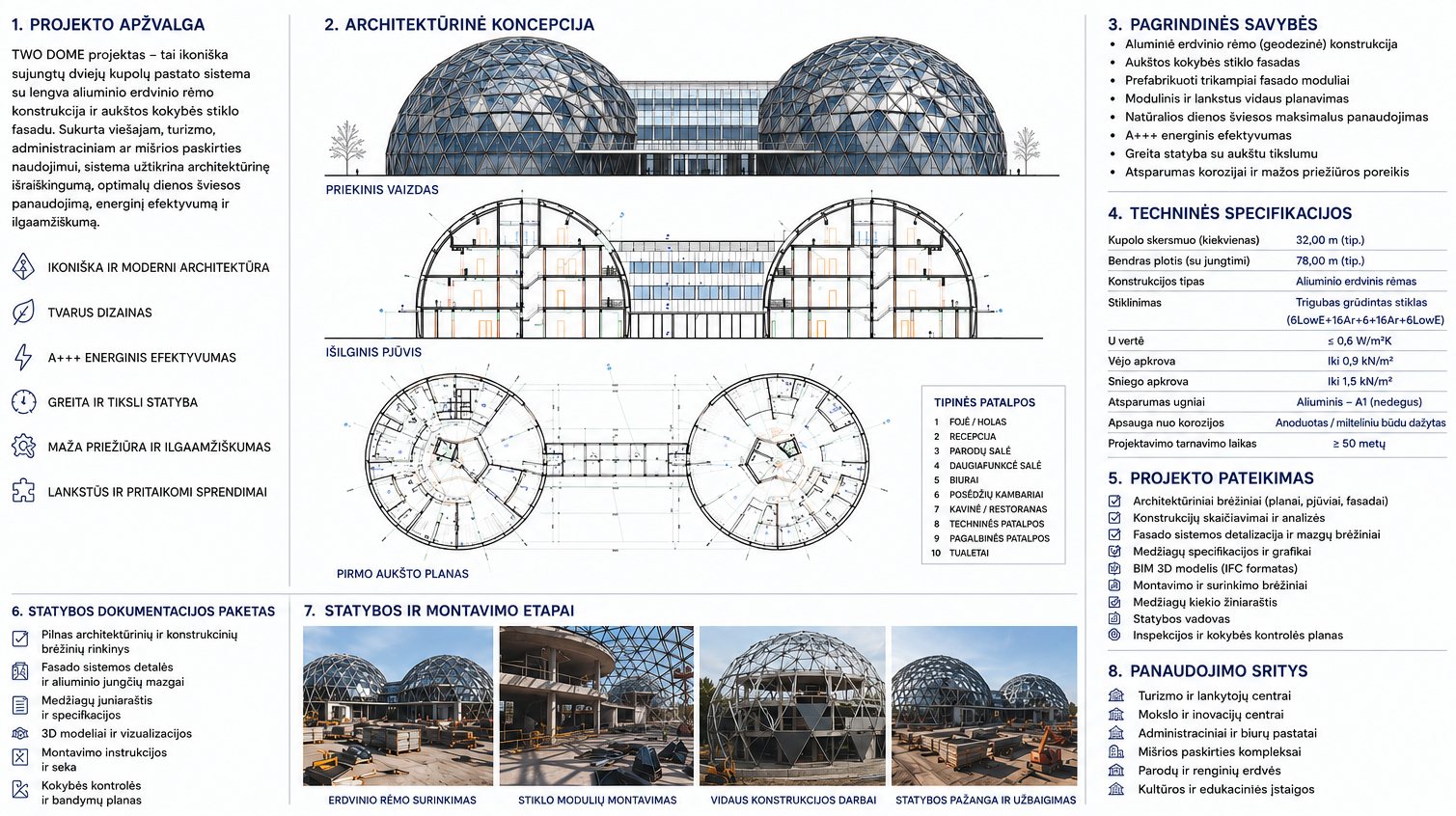
Two geodesic domes, a linking block and an internal multi-storey administrative frame.
The dome works as an external architectural and facade envelope, while inside a full administrative building is formed: floors, columns, stairs, service shafts, offices, conference zones, server rooms, client reception and rest areas.
General part
Indicators, use, building category, standards, annexes, design brief and client approvals.
Site
Site plan, levels, surfaces, fire access routes, utility networks, landscaping and protection zones.
Architecture
Plans, facades, sections, functions, materials, volumes, people flows and administrative programme.
Structures
Foundations, internal frame, dome network, nodes, FEM, stability, movement joints and load logic.
Engineering
Heat recovery, cooling, CO₂, server rooms, electrical capacity, lighting, lightning protection and building management.
Safety and construction
Fire alarm, access control, cameras, evacuation, construction organisation and quality checks.
SK / FEM analysis
Floor bending moments, load combinations, critical factors and dome deformation diagram for the Office Dome Campus structure.
Permit design package
Not a single beautiful album — a structured technical design file.
The GEODOMAS administrative dome route follows a repeatable template: from the initial design brief to signed technical design parts, review, INFOSTATYBA submission and working design / production documentation.
- Design brief, function, occupancy, energy class and safety requirements.
- Site documents: topography, geology, connection conditions, easements and access routes.
- Design proposals: volume, facades, height, indicators, presentation.
- Technical design: general plan, architecture, structures, HVAC, electrical, fire safety, security, construction organisation.
- Working design: profiles, nodes, glass, composite, numbering, packing and assembly instructions.
Construction readiness
A glass dome building starts not with glass but with site, function and the design brief.
Before choosing SSP1 / SSP2 system, glazing unit or composite ratio, you need to assess the site, use, permitting logic, utility connections and real usage scenario.
Site base
Use, terrain, access routes, easements, protection zones, fire appliance route and construction organisation area.
Documents
Land register extract, site plan, topography, geology, design conditions, connection conditions and preliminary indicators.
Function
Office, showroom, AI LAB, conferences, restaurant or mixed use. Function drives storeys, evacuation, HVAC and facade regime.
Scale
Diameter, area, number of storeys, people flows, internal frame, links between domes and service room requirements.
Engineering
Power, water, drainage, underfloor heating, heat recovery, cooling, BMS, server rooms, security and facade control.
Permits
Design proposals, technical design, review, INFOSTATYBA, working design and production / assembly documentation.
Glazing units and comfort
Light must be controlled: Low-E, Solar Control, COMBI glass and overheating control.
A premium glass office must be not only transparent but rational. Glazing units, solar control, HVAC, BMS and composite segments are selected by orientation, use and real usage scenario.
Low-E · more daylight
Used when maximum panorama, light and representative transparency are required.
Solar Control · facade comfort
Greater solar control for large office facades, south-facing zones and summer comfort.
SILVERSTAR COMBI / anti-solar logika
Solar-control glass + opaque triangles for privacy, service zones and overheating management.
*Figures are given as an indicative technical direction. Final parameters are refined per project, glass manufacturer datasheets, facade calculations and licensed specialist approvals.
Low U-value
Triple glazing units and Low-E coatings help reduce heat loss.
Solar Control
Solar-control coatings reduce overheating risk on large glass facades.
Daylight balance
The ratio of glass, shading and composite is aligned with internal comfort.
Facade integration
The solution is aligned with HVAC, BMS, drainage, condensation and airtightness nodes.
Glass selection logic
Not every glass suits a dome office — it is chosen by sun, loads, comfort and facade function.
In a dome, glass is not just a view. It is an element of heat, light, safety, acoustics and structural load, so the glazing unit is aligned with profile, composite zones, HVAC and BMS.
Orientation
South and west facades need stronger Solar Control logic, shading or composite zones.
Glass ratio
70–90% glass suits representation, but COMBI with 10–30% composite is often used for greater comfort.
Internal function
Offices, showrooms, restaurants, laboratories and conferences need different light, acoustic and privacy regimes.
Overheating
g-value, light transmittance, internal loads, heat recovery, cooling and automatic control are assessed.
Safety
Toughened / laminated glass, people flows, height, fall risks, entrance zones and maintenance scenarios.
A++ route
Ug, Uw, airtightness, thermal bridges and condensation control are refined in project energy calculations.
More transparency, more daylight, representative zones.
More solar control and comfort for south / west orientations.
Glass + composite when privacy, service zones and heat control are needed.
Trust architecture
Architects and developers need to see not only the visual but node logic.
GEODOMAS glass offices rely on control of profiles, sealing, drainage, glazing units and composite details. Each project is refined to structural and regulatory requirements.
Heavier real profile, node plates, numbered assembly sequence and quality control.
Gaskets and sealing systems separate glass from metal and control compression.
Facade nodes must have water, condensation and maintenance logic.
Loads, fire safety, A++ and CE / CPR questions are checked in the specific project.
Ready solution for architects
We deliver not only an idea — we deliver a clear brief for design.
Building function, room logic, facade direction, glass-to-composite ratio, node principles and production sequence are prepared so architect and developer see the full path from concept to delivery.
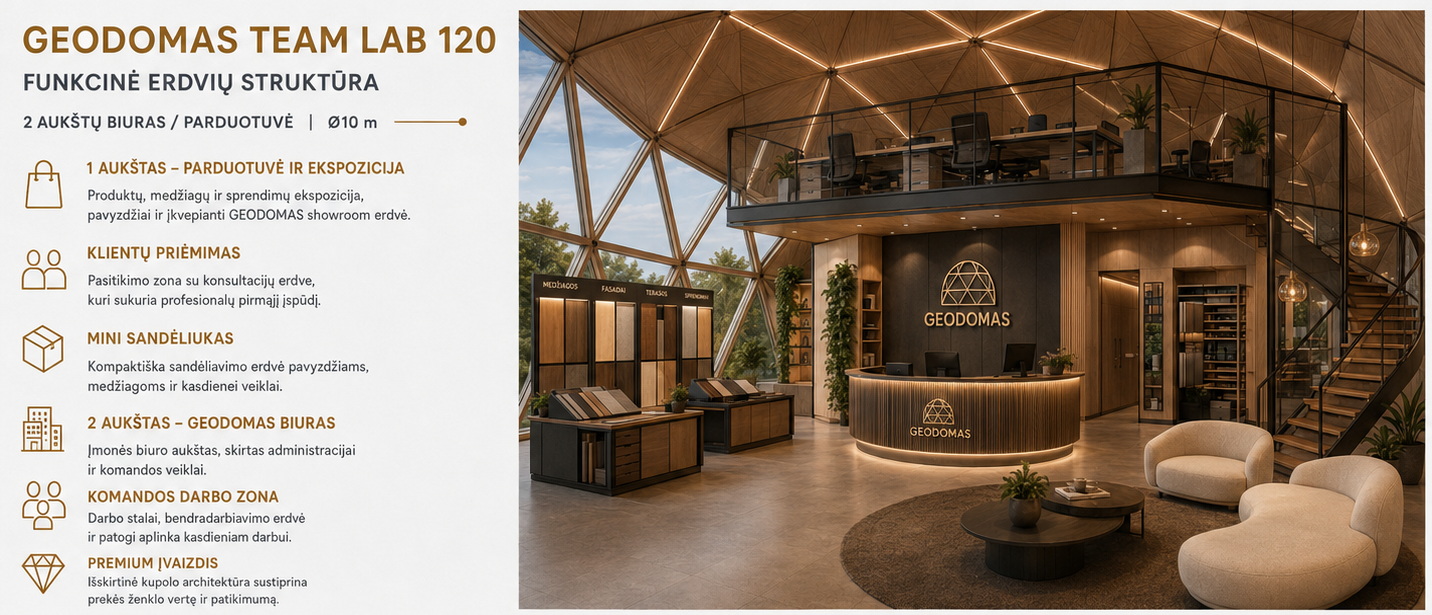
We create a building that speaks about your company before the client steps inside.
GEODOMAS · OFFICE SPACES · premium office
Risk and control
A glass dome must be not only beautiful but controlled.
Premium glass building quality is not determined by glass area alone. What matters is how sun, water, condensation, airtightness, loads, evacuation and long-term maintenance are controlled.
Solar Control, shading, composite zones, HVAC and BMS scenarios.
Thermal layers, ventilation, vapour control, thermal bridge analysis.
Drainage nodes, sealing layers, facade geometry and maintenance access.
Profile selection, node load capacity, triangle sizes and assembly sequence.
FEM, buckling analysis, joint tolerances and thermal movement.
Stairs, links between blocks, fire routes, alarms and people flows.
Glazing units, internal finishes, open spaces and work-zone comfort.
Cleaning, servicing, facade maintenance, replaceable segments and documentation logic.
Project process
From geometry to handover — a clear design, production and assembly sequence.
The glass dome is solved as an integrated engineering system: facade, internal frame, foundations, glazing units, composite, HVAC, BMS and quality control.
- 01 Concept Function, facade principle, preliminary areas and visualisations.
- 02 Design Architecture, structures, nodes, glazing units and composite.
- 03 Foundations Slab, anchors, MEP connections, heating, drainage and plinth logic.
- 04 Facade Frame, geodesic envelope, glass, sealing, drainage.
- 05 Handover HVAC / BMS integration, quality checks and documentation.
Structural analysis
Design relies not only on form but on real load modelling.
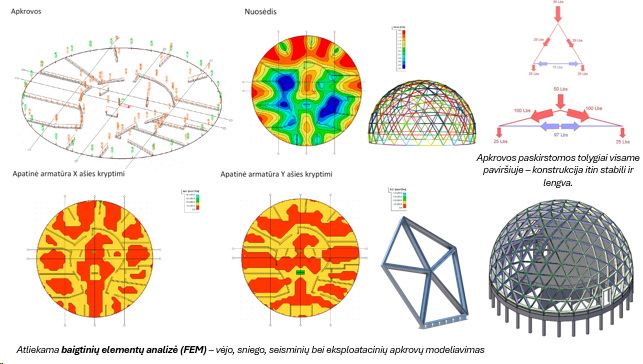
Before production and assembly, structural calculations are carried out: wind, snow, operational loads, settlement and geometry behaviour analysis. This allows precise selection of nodes, profiles, supports and glass / composite solutions.
- FEM analysis — geometry and load behaviour in the structure.
- Foundation logic — control of settlement, supports and load transfer.
- Dome frame — force distribution through the geodesic network.
- Design refinement — profiles, nodes and segments aligned to calculations.
01 / Concept and project vision
At the start, function, volume and glass-to-composite ratio are defined.
A clear architectural route is prepared: how many domes are needed, their function, how links work, where entrances are, which zones must be transparent, and where opaque / composite segments are needed.
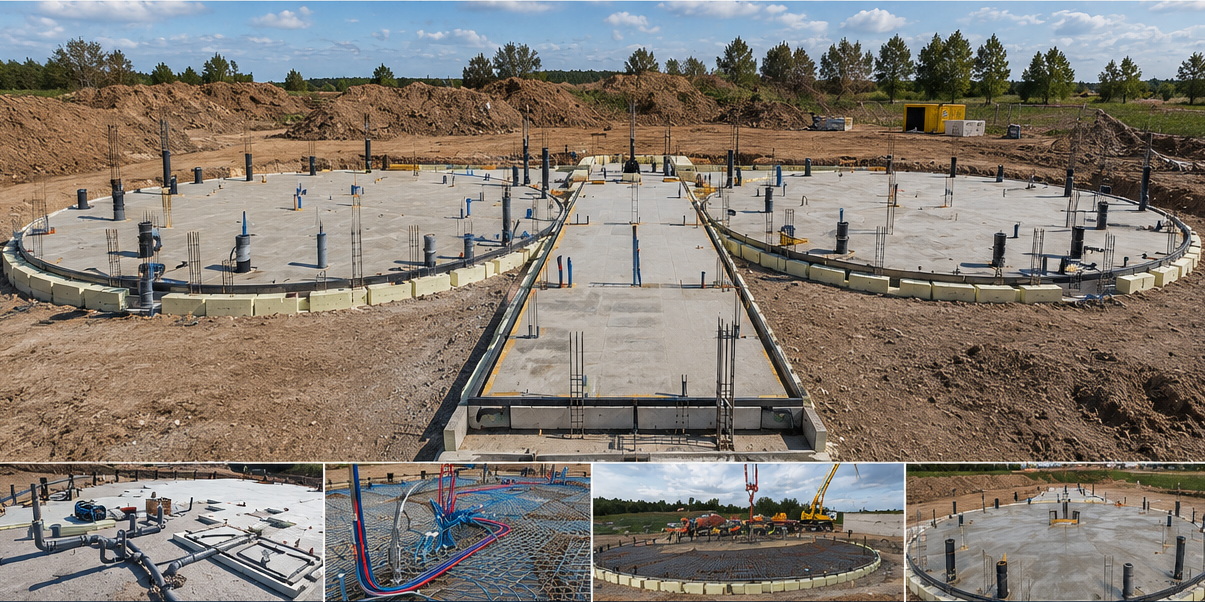
02 / Foundations and engineering preparation
Foundations are prepared as the base for the future geodesic facade and internal frame.
At this stage anchors, connections, drainage, underfloor heating / MEP routes, internal frame loads and precise fixing of dome geometry to the base are resolved.
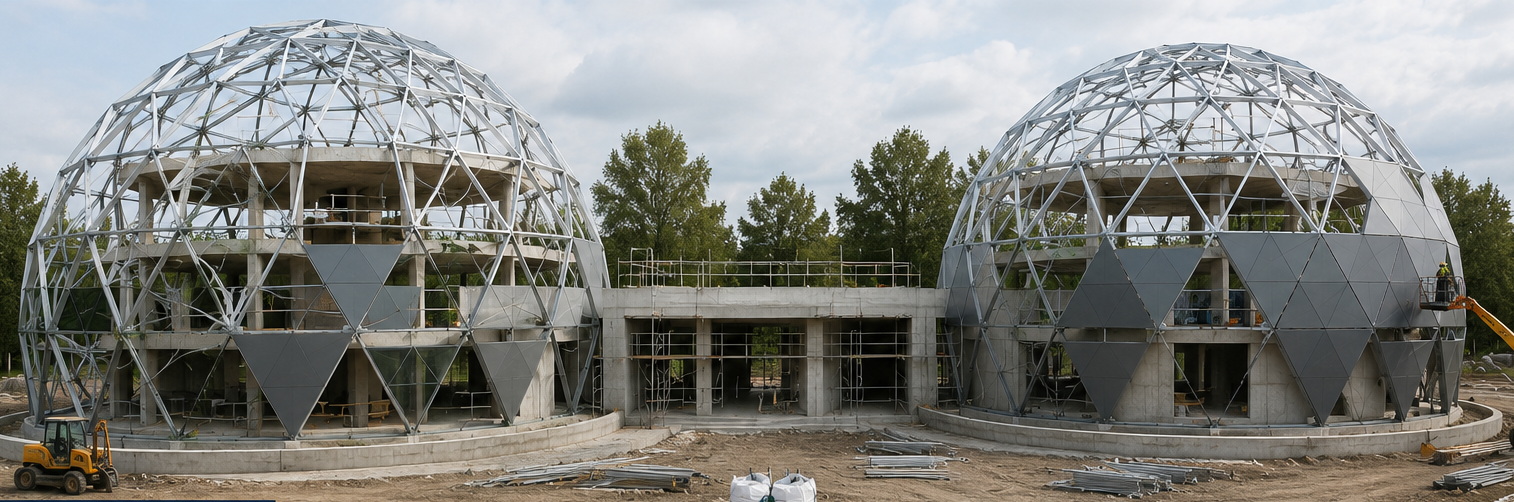
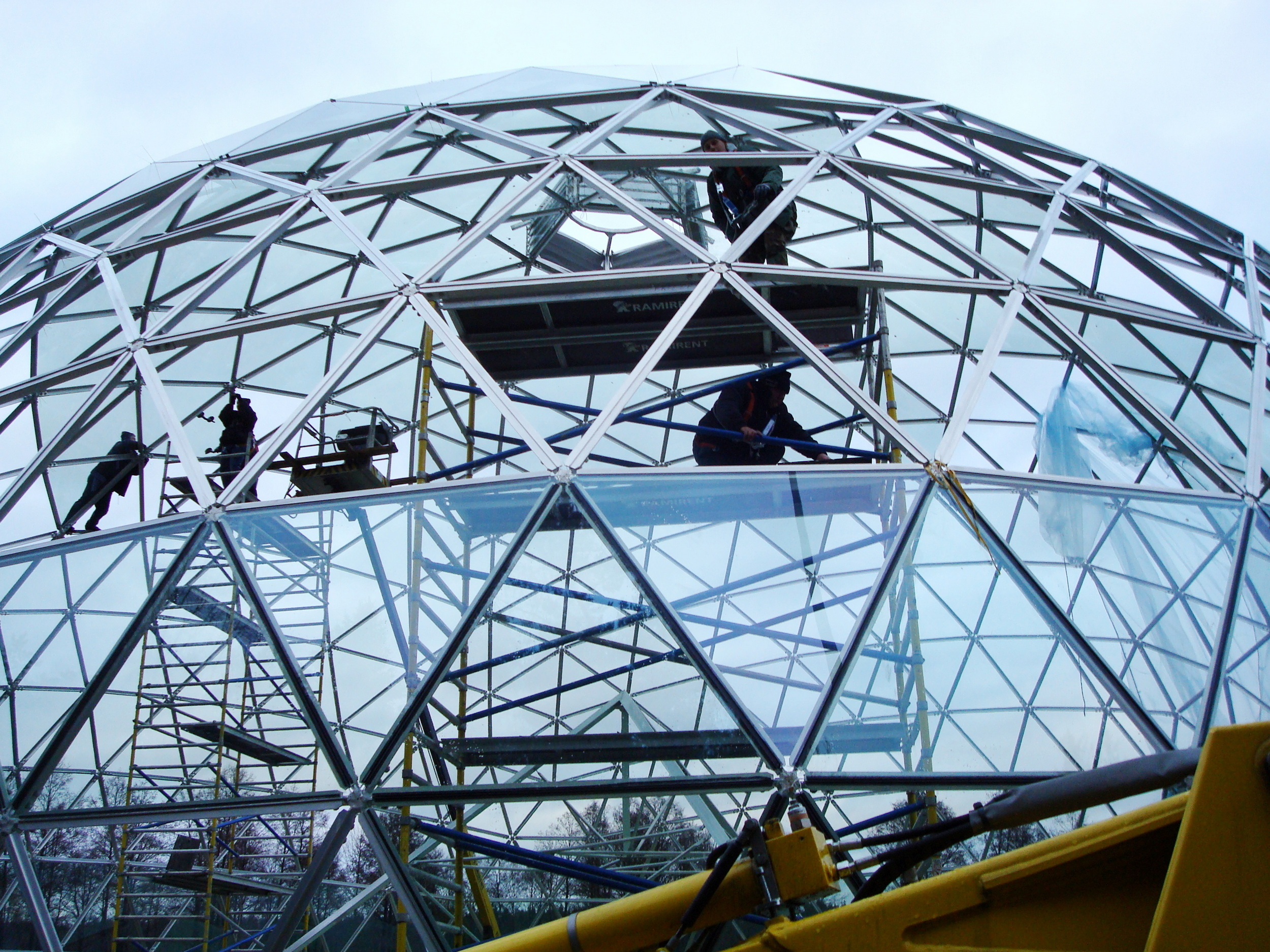
03 / Frame and glass facade assembly
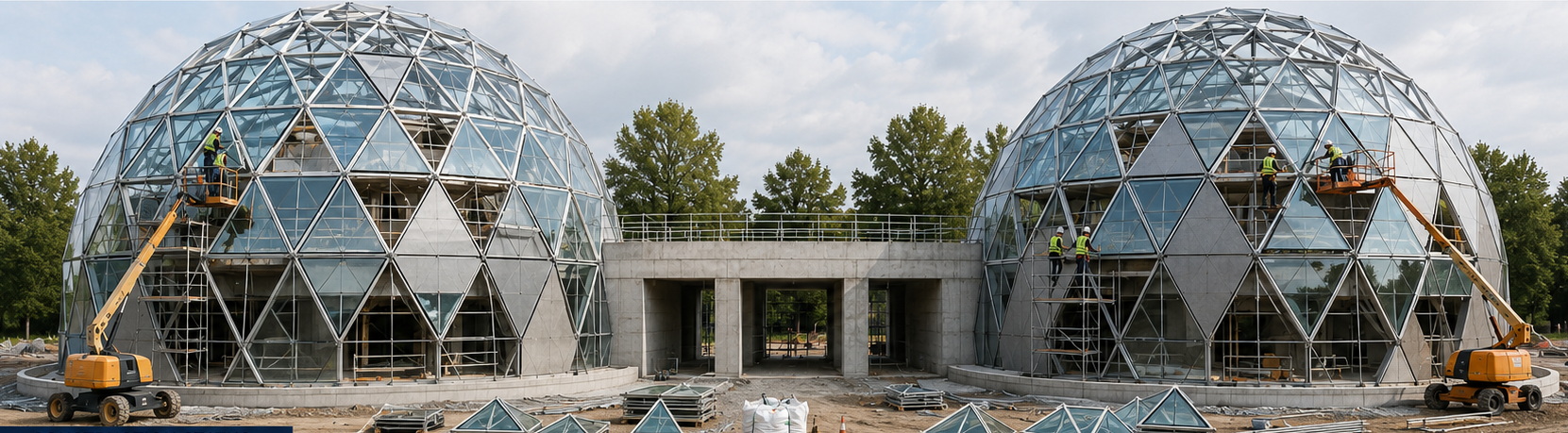
The geodesic envelope is assembled as a numbered aluminium-glass system.
Aluminium profiles, triangular modules, composite segments, glazing units, sealing and drainage nodes are assembled in a pre-planned sequence.
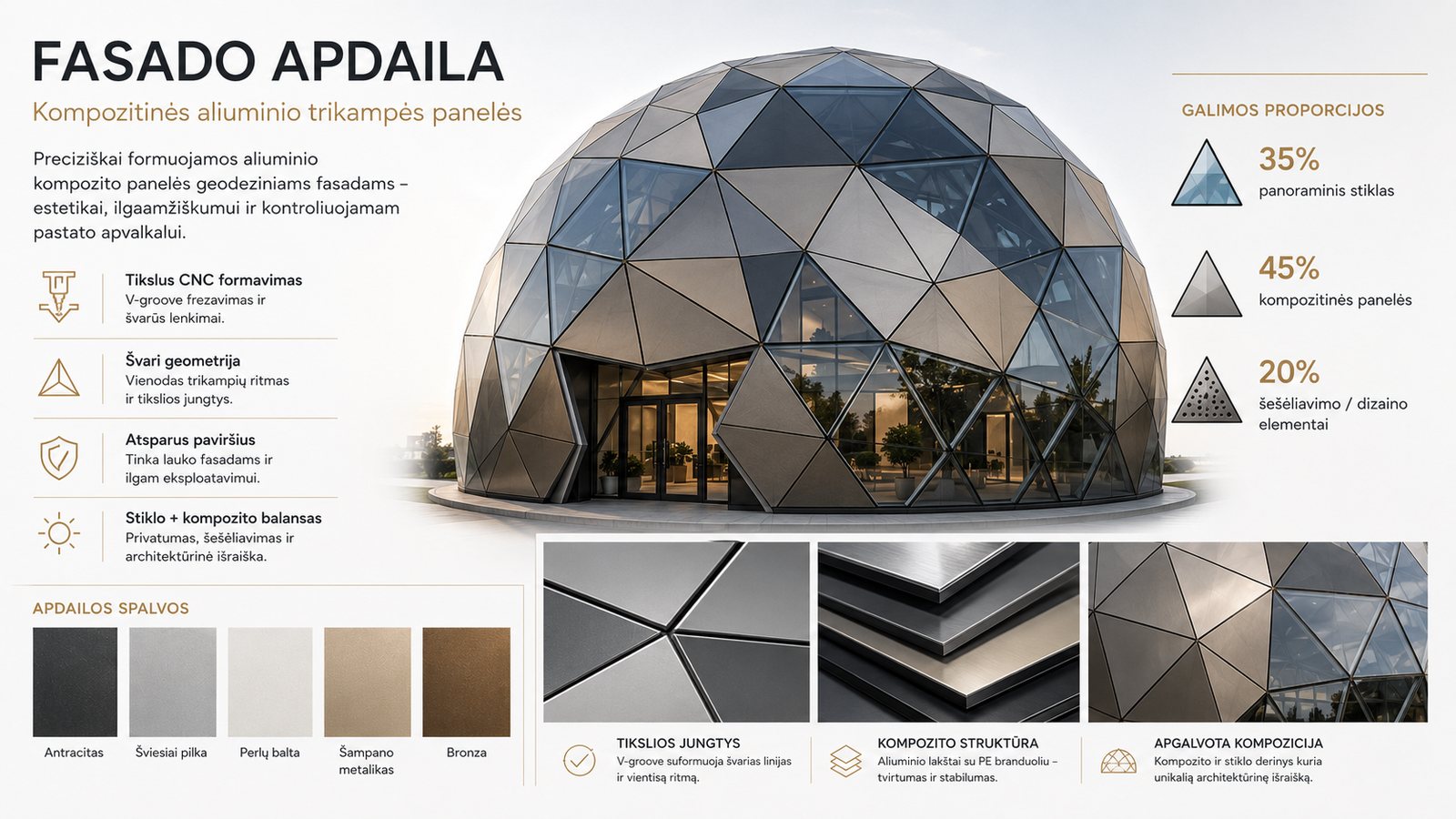
03B / Facade finish
Composite aluminium triangular panels — the glass dome facade control layer.
Composite triangles are used where privacy, solar control, service zone covering, shading or stronger architectural expression are needed. Thus the glass dome becomes not only transparent but a balanced facade product.
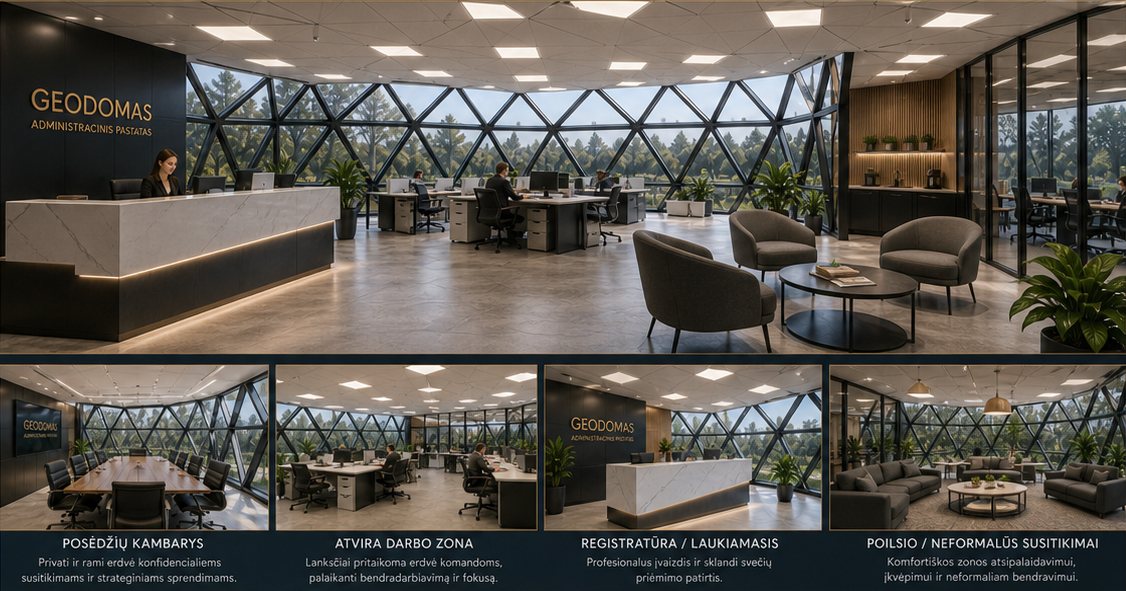
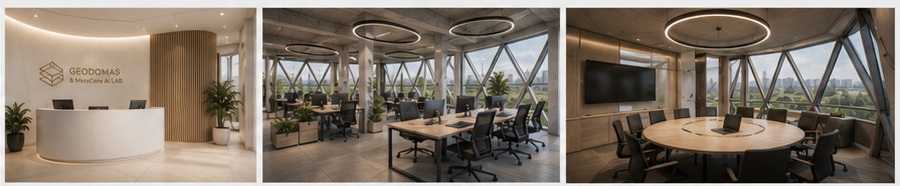
04 / Internal spaces and work function
Inside, a real office is formed — not just a beautiful dome view.
Reception, work zones, meeting rooms, lounge, executive areas, service rooms and lighting are aligned with facade rhythm and internal comfort.
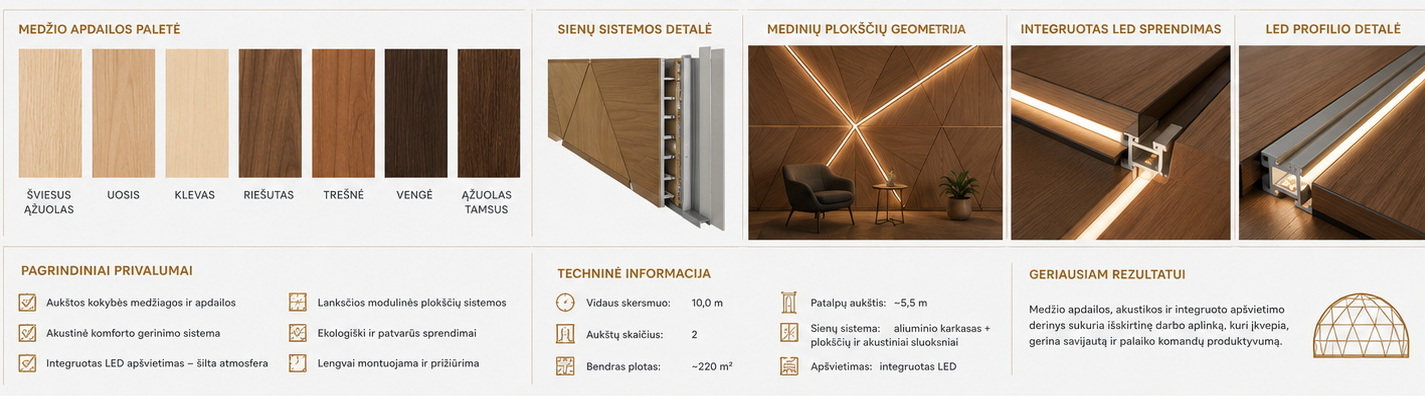
04B / Internal finishes and atmosphere
Interior materials, light and work-zone aesthetics are presented as a ready solutions pack.
We show not only the overall internal vision but concrete interior scenarios: client reception areas, exhibition spaces, finish materials, wood textures, integrated LED lighting and premium workplace character.
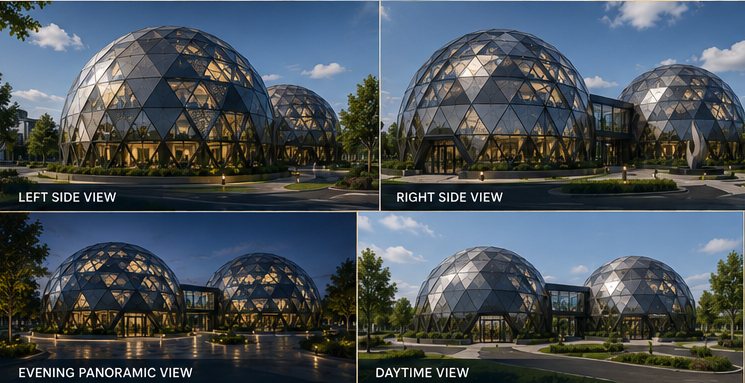
05 / Final result
Premium glass office campus ready for handover.
The final result is a representative building with clear function, controlled glass facade, composite segments, lighting, engineering and premium business identity.
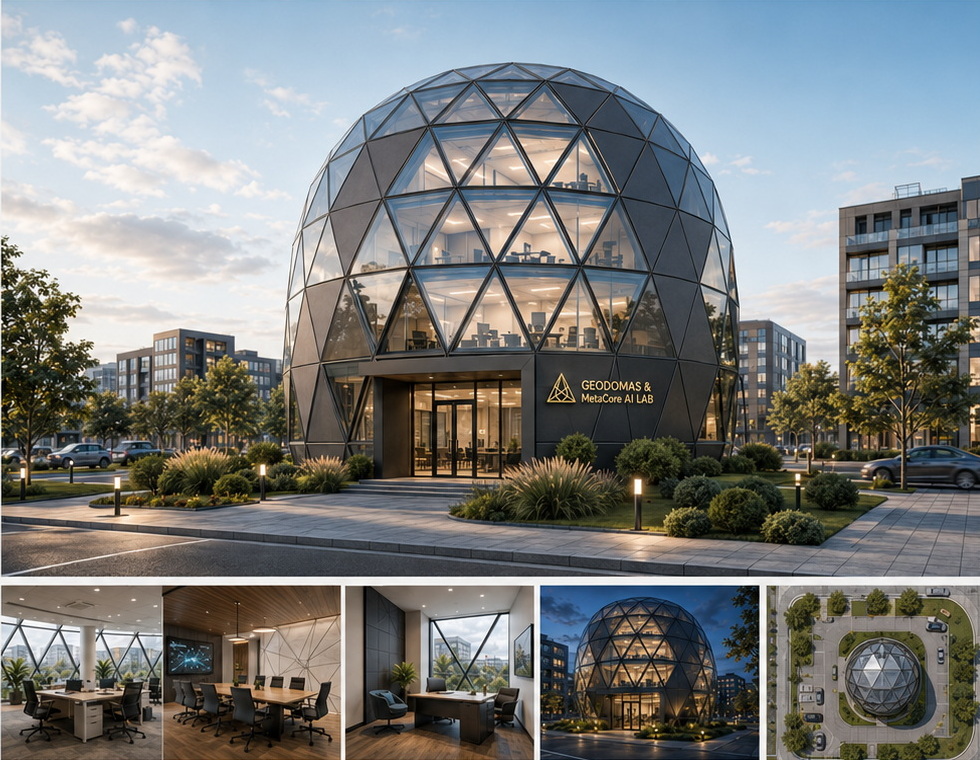
Portfolio / deliveries
Glass dome offices — GEODOMAS project and concept gallery.
Facade assembly, interiors, campus solutions and representative spaces from our portfolio — scroll or let the carousel show the full project set.
How we work
One project — clear responsibilities for architect, developer, engineer and production.
GEODOMAS hands the client not a pile of files but a working system: product scenario, facade logic, documentation route, production preparation and assembly sequence.
Concept, plan direction, facade logic, node principles, material palette and list of technical questions.
Product scenario, phasing, commercial value, preliminary kitting and risk management.
Structure for load, facade, HVAC, energy, fire safety and airtightness questions.
Preparation of profiles, glass, composite, CNC, numbering, packing and assembly sequence.
Frequently asked questions
What is worth clarifying before starting a glass dome office project?
How do SSP1 Heavy and SSP2 Compact differ?
SSP1 Heavy suits larger A++ administrative buildings with a heavier profile, triple glazing units and higher loads. SSP2 Compact fits smaller offices, showrooms and more rational premium projects.
Can a dome house a 2–4 storey office?
Yes, when the dome works as an external geodesic facade envelope and a separate reinforced-concrete, steel or hybrid administrative frame is designed inside.
How much glass and how much composite is recommended?
Preliminary glass-to-composite balance is used by function: panoramic zones, privacy, solar control, service rooms and facade rhythm. Architecture, HVAC and energy calculations refine the final ratio.
Can A++ / A+++ class be targeted?
Yes, but it is not only a glazing unit question. The whole system is needed: frame, airtightness, thermal bridges, HVAC, BMS, solar control and project energy calculations.
Where to start?
From function, site, planned area, number of storeys, people flows, glass / composite ratio and desired documentation stage.
For your project
The first conversation should start from building function and facade logic.
Write whether you are interested in a single glass office, two linked domes, AI LAB, an administrative campus or a glass home. We will then choose the route and next step.